

How a Nordic insurer partnered with Trigo to create a digital-first musculoskeletal pathway to improve access, reduce treatment intensity and explore new opportunities for claims efficiency.
Executive Summary
Musculoskeletal (MSK) conditions remain one of the largest drivers of healthcare utilisation, treatment expenditure and workplace absence across Europe.
Traditional insurer-funded physiotherapy pathways often operate through a fee-for-service model in which treatment volume is authorised at claim initiation and ongoing utilisation receives limited active management.
A Nordic insurer partnered with Trigo to test an alternative approach.
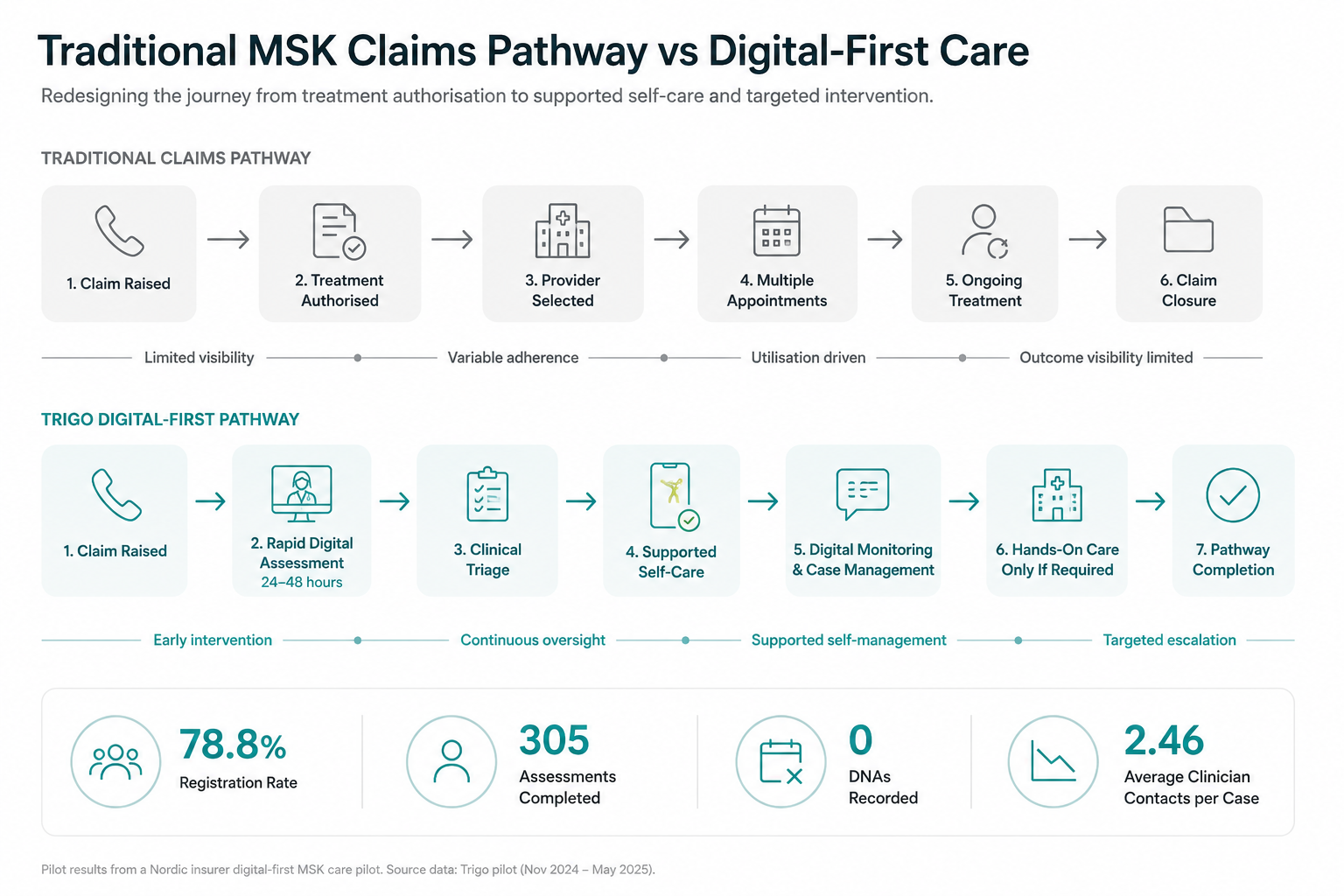
The pilot introduced a digital-first pathway that combined rapid physiotherapy assessment, structured triage, supported self-care and digital treatment delivery with managed escalation to ‘hands-on’ physiotherapy where required.
The objective was not simply to digitise existing care. The objective was to determine whether earlier assessment, structured pathway management and supported self-care could create a more efficient musculoskeletal claims model.
The pilot demonstrated:
- Strong claimant acceptance.
- High registration and attendance rates.
- Zero recorded “Did Not Attend” (DNA) appointments.
- High engagement once treatment commenced.
- Average treatment intensity of 2.46 clinician contacts per digitally managed case.
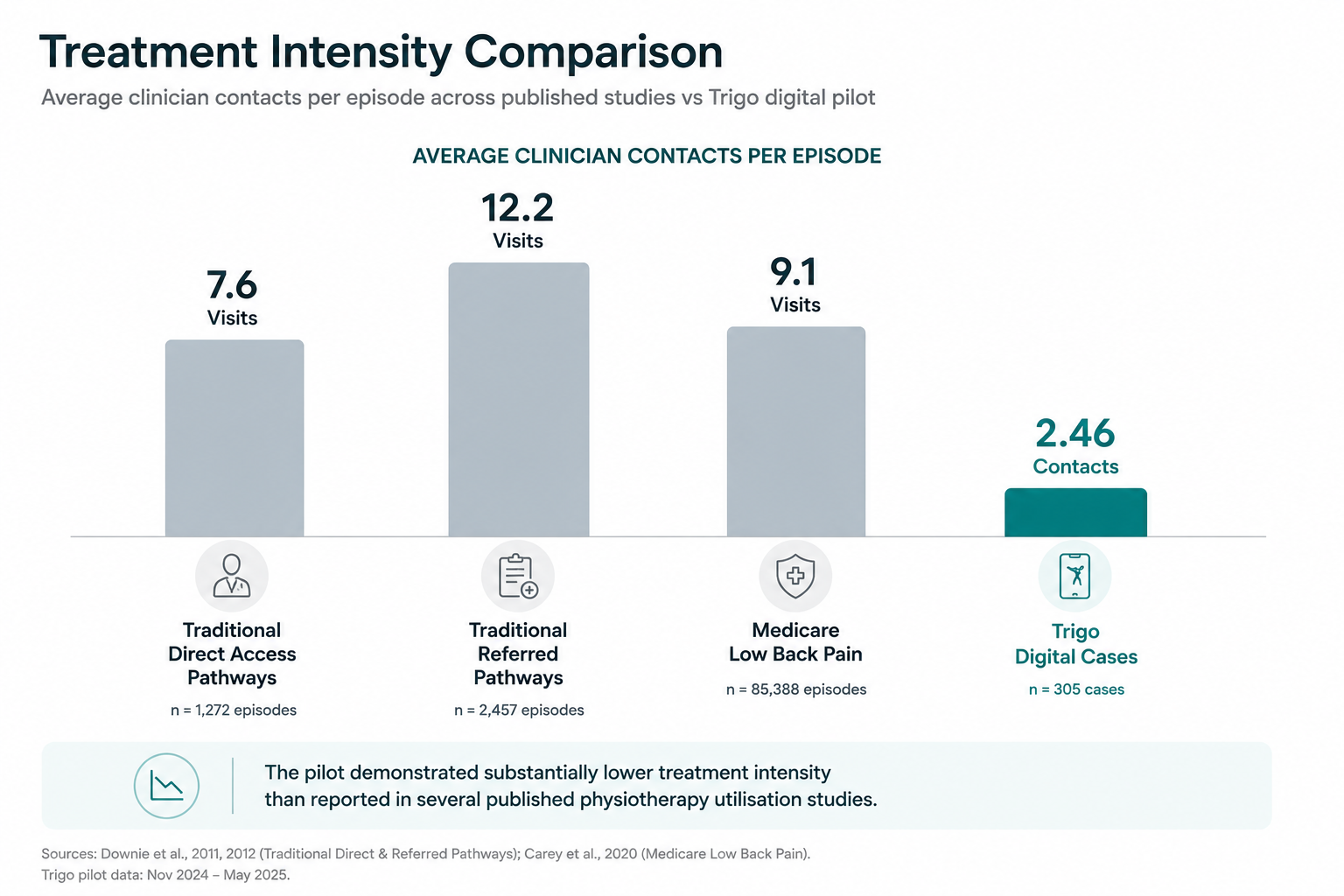
Published claims analyses report average physiotherapy utilisation of approximately 7.6 visits per episode for direct-access pathways and 12.2 visits per episode for physician-referred pathways (American Physical Therapy Association, 2025).
While the pilot was not designed to measure cost savings directly, the observed treatment intensity suggests a potentially significant opportunity for further economic evaluation.
The Challenge
The insurer’s existing musculoskeletal pathway reflected a traditional model commonly used throughout the industry.
A claimant would:
- Contact the insurer.
- Receive authorisation for treatment.
- Select a provider from an approved network.
- Attend physiotherapy sessions as required.
While operationally simple, this model presents several challenges:
- Limited visibility of treatment progression.
- Limited influence over utilisation patterns.
- Variable adherence.
- Little structured support between appointments.
- Limited ability to identify opportunities for pathway optimisation.
The insurer wanted to explore whether a digital-first model could provide earlier intervention, improved pathway visibility and more efficient utilisation of physiotherapy resources.
Why This Matters
Musculoskeletal conditions represent one of the most significant categories of healthcare expenditure for insurers and employers.
Research increasingly suggests that:
- Early intervention improves pathway efficiency.
- Telehealth can achieve outcomes comparable to face-to-face physiotherapy for many MSK presentations.
- Supported self-management can reduce dependency on repeated treatment.
- Engagement and adherence play critical roles in clinical and economic outcomes.
Marks et al. (2023) found that telehealth physiotherapy can achieve outcomes comparable to traditional delivery while improving access and reducing costs.
Bargeri et al. (2024) reported strong evidence supporting telemedicine for musculoskeletal disorders, including improved accessibility and high patient satisfaction.
Baumbach et al. (2024) identified active rehabilitation and self-management approaches as economically attractive components of physiotherapy delivery.
Together, these studies suggest that pathway design may be as important as treatment delivery itself.
The Trigo Model
The pilot introduced a new front-door pathway.
Step 1: Insurer Referral
Claimants were referred directly to a physiotherapist via the Trigo platform, following first contact with the insurer.
Step 2: Rapid Access Assessment
Participants were invited to register on Trigo and book a 15-minute digital consultation with a physiotherapist, targeted within 24–48 hours.
Step 3: Clinical Suitability Assessment
The physiotherapist evaluated:
- Suitability for digital treatment.
- Patient willingness to engage with digital care.
Step 4: Supported Self-Care and Digital Treatment
Suitable participants entered a Trigo-managed pathway that included:
- Video consultations.
- Exercise prescription.
- Progress monitoring.
- Messaging support.
- Behavioural nudges.
- Structured self-management.
Step 5: Escalation Where Required
Where digital treatment was unsuitable or declined, participants were directed into hands-on physiotherapy pathways. The Trigo physiotehrpist assumed the role of case manager and liaison to ensure treatment was progressing, clinically appropriate and necessary.
Pilot Participation
The pilot generated strong claimant engagement.
Registration
- 443 claimants were referred.
- 349 users registered on Trigo.
- Registration rate: 78.8%.
For an insurer-led referral model, this represented strong claimant acceptance of the digital-first approach. The hook was a rapid access conversation with a qualified physiotherapist.
Assessment Attendance
- 305 claimants attended an initial assessment.
- Zero DNAs were recorded.
- Cancellations typically resulted in rebooking.
The absence of DNAs is particularly significant because non-attendance represents a common source of inefficiency within outpatient physiotherapy pathways.
Treatment Pathway Progression
Following assessment:
- 53 users progressed into at least one full digital treatment pathway appointment.
- This represented 17.4% of assessed users.
Importantly, this figure should not be interpreted as rejection of digital care.
The pilot did not systematically record:
- Clinical suitability.
- User consent.
- Operational follow-up factors.
As a result, the reasons for non-progression cannot currently be separated.
One of the key objectives of the next pilot opportunity is to measure these variables explicitly.
Digital Treatment Efficiency
The most significant pilot finding emerged once participants entered an active digital treatment pathway.
Observed Performance
- Attendance remained high.
- DNAs remained at zero.
- Engagement and adherence remained strong.
- Average treatment intensity was 2.46 clinician contacts per case.
This figure is particularly important when viewed alongside published utilisation benchmarks.
Published Comparison
Large physiotherapy utilisation studies report substantially higher treatment intensity within conventional pathways.
Examples include:
- 7.6 visits per episode in direct-access physiotherapy populations.
- 12.2 visits per episode in physician-referred pathways.
- Approximately 9.1 visits per episode in Medicare low-back-pain populations.
- Source: American Physical Therapy Association (APTA). (2025).
These findings suggest that the Trigo pathway operated with materially lower treatment intensity than many conventional models.
The observed utilisation difference represents a credible opportunity for delivering cost-effective MSK interventions and a substantial potential cost saving.
Alignment With Research
One of the strongest aspects of the pilot is its consistency with the published evidence base.
Telehealth Physiotherapy
Marks et al. (2023) demonstrated that telehealth physiotherapy can achieve outcomes comparable to face-to-face delivery while improving accessibility.
The pilot’s high attendance and zero DNA rates align with this principle.
Digital Musculoskeletal Care
Bargeri et al. (2024) concluded that telemedicine is clinically effective across many musculoskeletal conditions.
The pilot demonstrates operational feasibility within a real-world insurance setting.
Supported Self-Care
Baumbach et al. (2024) identified active participation and self-management as important contributors to value and efficiency.
Supported self-care formed the core operating model of the Trigo pathway.
Engagement and Adherence
Milne-Ives et al. (2023), Edwards et al. (2016) and Alzghoul et al. (2024) all highlight the importance of behavioural support, progress visibility and ongoing engagement.
These mechanisms were embedded throughout the pilot.
Economic Opportunity
The pilot was not designed to prove financial outcomes.
However, it demonstrated several conditions associated with improved pathway efficiency:
- Rapid access.
- Zero DNAs.
- High attendance.
- Structured pathway management.
- Supported self-care.
- Lower treatment intensity.
Using illustrative modelling assumptions, Trigo estimated potential direct treatment cost reductions of at least 10% and up to 45%, depending on pathway performance and utilisation reduction.
What The Pilot Demonstrated
The pilot successfully demonstrated that:
- Insurer-led referral into Trigo is operationally viable.
- Claimants are willing to engage with digital-first pathways.
- Rapid access improves attendance.
- Supported self-care can be integrated into MSK claims management.
- Digitally managed cases can operate at substantially lower treatment intensity than commonly reported conventional pathways.
Results Snapshot
443 Claimants Referred
349 Registrations
78.8% Registration Rate
305 Initial Assessments Completed
0 DNAs Recorded
53 Digital Treatment Pathways Initiated
2.46 Average Clinician Contacts Per Digital Case
Potentially 10% to 45% Illustrative Reduction In Direct Treatment Spend (Modelled Scenario)
References
American Physical Therapy Association (APTA). (2025). State of Direct Access to Physical Therapy in the United States: Utilisation and Cost Analysis. Alexandria, VA: American Physical Therapy Association.
Milne-Ives, M., et al. (2023). Potential Associations Between Behaviour Change Techniques and Engagement With Mobile Health Apps.
Edwards, E. A., Lumsden, J., Rivas, C., et al. (2016). Gamification for Health Promotion: Systematic Review of Behaviour Change Techniques in Smartphone Apps. BMJ Open.
Alzghoul, A., Alkhazaleh, Z., Alkhawaldeh, M., et al. (2024). The Effectiveness of Gamification in Health and Wellbeing: A Systematic Review and Meta-Analysis. The Open Public Health Journal.
Baumbach, P., Roheger, M., Katalinic, O. M., et al. (2024). Cost-Effectiveness of Treatments for Musculoskeletal Conditions Offered by Physiotherapists: A Systematic Review. Sports Medicine – Open.
Marks, D., et al. (2023). The Health Economic Impact of Musculoskeletal Physiotherapy Delivered by Telehealth: A Systematic Review.
Bargeri, S., et al. (2024). Effectiveness of Telemedicine for Musculoskeletal Disorders: Umbrella Review. Journal of Medical Internet Research.
American Physical Therapy Association. (2025). State of Direct Access and Utilisation Analysis.
APTQI. (2017). Physical Therapy Episodes for Low Back Pain: Utilisation Analysis of Medicare Beneficiaries.
Marrache, M., et al. (2022). Early Physiotherapy and Healthcare Utilisation in Low Back Pain Pathways.