
Trigo
“Before wellbeing programmes can improve organisational outcomes, employees must first choose to participate.”
Why engagement matters
Research consistently identifies employee engagement and sustained participation as critical determinants of workplace wellbeing programme success. Studies of workplace wellbeing and digital health interventions have repeatedly shown that providing access alone does not create behaviour change. Participation is the essential bridge between investment and impact.
The challenge facing employers
Many employers already provide access to wellbeing resources and support services. However, research into digital health interventions demonstrates that participant attrition is common. Sustaining engagement over time remains one of the biggest challenges facing workplace wellbeing initiatives.
The municipal pilot
The pilot was delivered across all municipal kindergarten locations using the Trigo supported self-care platform. Employees were encouraged to engage through behavioural nudges, challenges, gamification, rewards, progress tracking and motivational communications. The objective was not simply awareness. The objective was participation.
Participation across the workforce
Every participating location achieved employee activation. Approximately two-thirds of employees actively engaged with the programme. Participation increased during the pilot rather than declining after launch, suggesting that engagement became embedded within everyday working life.
From registration to behaviour change
The strongest findings related to employee behaviour rather than simple platform usage. More than 80% of participating employees recorded physical activity. Almost 80% achieved recognised WHO physical activity targets at least once. Nearly 90% engaged with routines designed to support positive habits. Almost half tracked sleep. Employees also engaged with hydration tracking, lifestyle assessments and personalised wellbeing tools.
Creating a culture of participation
The programme combined supported self-care with challenges, rewards, gamification and positive reinforcement. Employees were encouraged to set goals, track progress and receive recognition for positive actions. Healthy behaviours were made visible, achievable and rewarding.
Why this matters for employers
Norwegian policy and research consistently highlight the importance of prevention, workplace participation and early engagement. Although this pilot does not demonstrate reductions in sickness absence or organisational costs, it demonstrates that employees are willing to engage with supported self-care when the proposition is relevant, motivating and accessible.
The evolution towards a preventative health ecosystem
The pilot provides a foundation for a broader preventative health ecosystem. The long-term vision combines supported self-care, behavioural engagement, educational content, wellbeing monitoring, professional support and workforce participation initiatives within a single framework.
What employers can learn
The pilot answered an important question. Employees will participate. They will engage with positive health behaviours. They will return repeatedly. For employers seeking to strengthen workforce participation and preventative health, engagement is the foundation upon which future outcomes can be built.
Why this matters – at a glance
- 100% location activation
- 67% workforce participation
- 80%+ physical activity engagement
- 80% WHO target achievement
- 90% routine engagement
- Increasing participation over time
Conclusion
The pilot does not yet demonstrate reductions in sickness absence, healthcare utilisation or organisational costs. Those outcomes require further evaluation. What it does demonstrate is that employees are willing to engage with supported self-care when the experience is relevant, motivating and easy to access. For organisations seeking to strengthen workforce participation and preventative health, engagement is where meaningful change begins.
References
- Eysenbach G. The Law of Attrition. Journal of Medical Internet Research. 2005;7(1):e11. jmir.org
- Goetzel RZ et al. Do Workplace Health Promotion (Wellness) Programs Work? Journal of Occupational and Environmental Medicine. 2014;56(9):927-934. pubmed.ncbi.nlm.nih.gov
- Murray E et al. Attrition Revisited: Adherence and Retention in a Web-Based Alcohol Trial. Journal of Medical Internet Research. 2013;15(8):e162. pmc.ncbi.nlm.nih.gov
- Geraghty AWA et al. Understanding Attrition from Internet Health Interventions. Health Promotion International. 2013;28(3):442-452. academic.oup.com
- Letter of Intent regarding a More Inclusive Working Life (IA Agreement). Norwegian Government.
- STAMI. The Inclusive Workplace Agreement contributed to keeping paid employment. stami.no
Introduction
For more than twenty-five years I have worked as a physiotherapist and coach, supporting everyone from people living with persistent pain to elite athletes competing at the highest level. Throughout that journey, one observation has remained remarkably consistent.
The people who achieve the best long-term outcomes are rarely those who simply receive the most treatment. They are the people who gain understanding, build confidence and gradually learn to take an active role in their own health.
That insight became the foundation for Trigo. Our ambition has never been to replace healthcare professionals with technology. Instead, we believe digital tools should make expert support more accessible, more connected and more sustainable. We call this philosophy supported self-care.
Moving beyond the traditional treatment model
Most of the decisions that influence our wellbeing happen outside the clinic. How active we are, how we sleep, how we respond to stress and how connected we feel all shape our health. The role of modern healthcare should therefore be to help people understand these factors and give them the confidence to act on them. The goal is not independence from professionals. The goal is partnership.
A human-centred philosophy
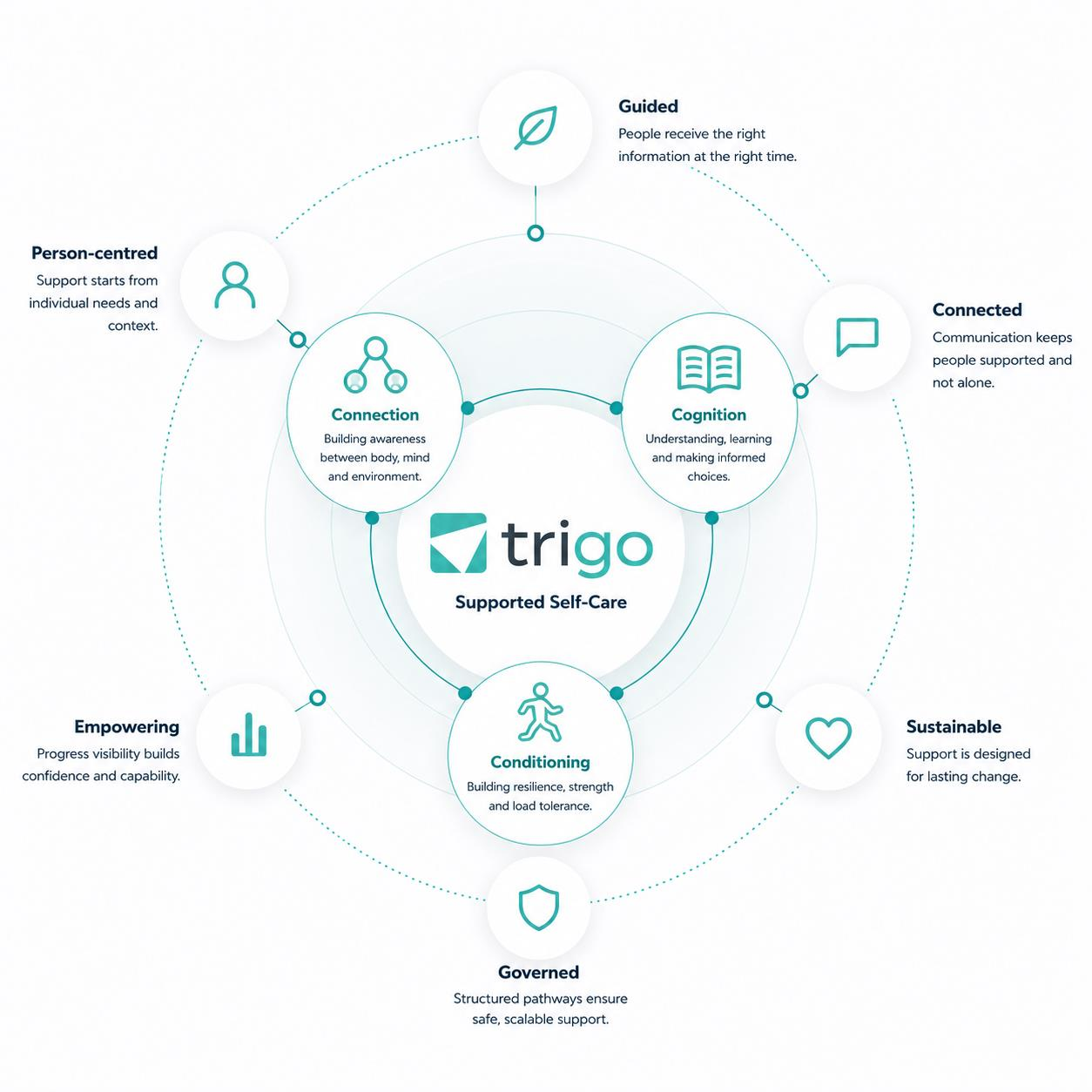
At Trigo, we see people as biological, psychological and social beings. Lasting improvements often come from understanding how these dimensions interact. This is why our model combines digital guidance with human expertise, structured pathways, educational content, communication tools and ongoing engagement.
The three pillars of the Trigo approach
Connection – Building awareness between body, mind and environment, while recognising the value of support from others.
Cognition – Increasing understanding and health literacy so that people can make informed decisions and become active participants in their own wellbeing.
Conditioning – Building resilience, strength, mobility and load tolerance through practical, achievable activities that fit everyday life.
Small actions. Sustainable change.
Our experience suggests that people are far more likely to succeed when they can take small, manageable steps that fit naturally into daily life. Success creates confidence. Confidence builds momentum. Over time, these small changes accumulate into meaningful and lasting improvements.
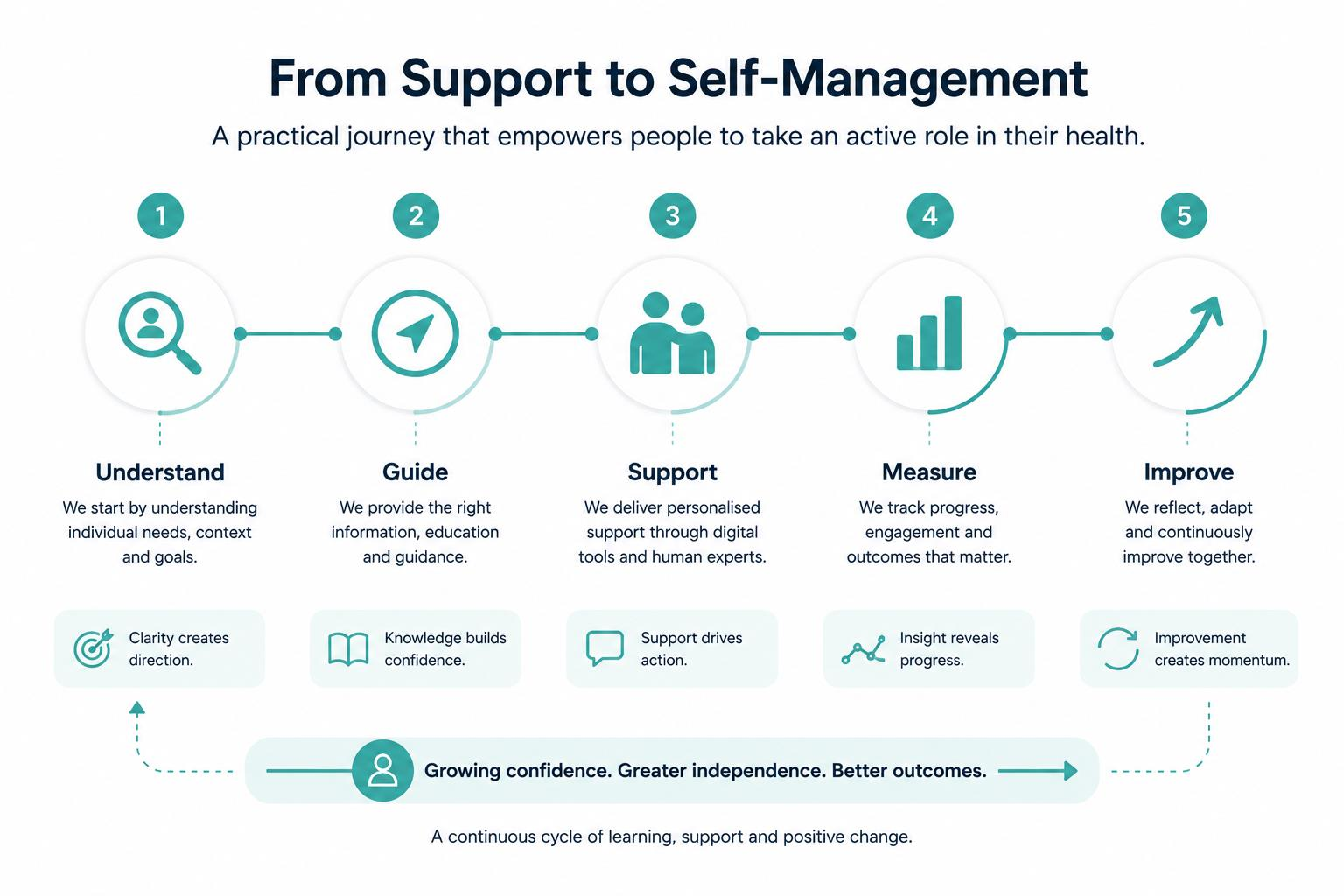
Supported self-care does not mean unsupported care
The purpose of supported self-care is to ensure that professional expertise is used where it creates the greatest value. Digital structure helps with communication, education, routine follow-up and progress visibility, while clinicians and coaches provide reassurance, assessment and guidance when it matters most.
Why this matters for organisations
Supported self-care helps organisations move from reactive treatment towards proactive support. It enables earlier conversations, clearer pathways and a better understanding of how people are progressing over time. That is why we increasingly describe Trigo as an infrastructure for supported self-care.
Looking ahead
The future of health and wellbeing will not be built around choosing between technology and people. It will come from combining the strengths of both. With the right knowledge, the right support and the right encouragement, small actions can create lasting change. That is the philosophy behind Trigo.
Healthcare Was Never Designed for the Challenges We Face Today
Across Europe and much of the developed world, healthcare systems are under increasing pressure.
People are living longer. Chronic conditions are becoming more common. Mental health concerns are growing. Musculoskeletal complaints remain one of the leading causes of disability and sickness absence. At the same time, healthcare providers face workforce shortages, increasing demand and finite resources.
In response, healthcare systems have traditionally done what they were designed to do: treat illness.
When someone develops a health problem, they enter a pathway of assessment, diagnosis and intervention. For many conditions, this approach works well. Modern healthcare has transformed outcomes across countless areas of medicine.
However, there is a growing recognition that many of today’s health challenges cannot be solved through treatment alone.
The question increasingly being asked by researchers, policymakers and employers is not simply:
“How do we treat people when they become unwell?”
It is:
“How do we help people stay well in the first place?”
This question sits at the heart of a growing body of research exploring digital wellbeing.
It is also one of the questions that ultimately influenced the development of the Trigo platform.
The Evolution from Digital Health to Digital Wellbeing
For many years, the term digital health was primarily associated with healthcare delivery.
Digital systems helped clinicians:
- Record patient information.
- Deliver consultations.
- Monitor health conditions.
- Support diagnosis and treatment.
These remain important functions.
However, researchers have increasingly recognised that health is influenced by far more than clinical interventions alone.
In their systematic scoping review, Smits et al. (2022) describe an emerging shift from digital health towards digital wellbeing.
This distinction is important.
Digital health is largely concerned with healthcare services.
Digital wellbeing takes a broader view.
It includes:
- Prevention.
- Behaviour change.
- Lifestyle support.
- Self-management.
- Quality of life.
- Social wellbeing.
- Ongoing participation in health.
The focus moves beyond managing illness and towards supporting wellbeing.
This represents a significant change in perspective.
Rather than asking:
“How do we deliver treatment digitally?”
the question becomes:
“How can digital tools help people make healthier decisions, build healthier habits and maintain wellbeing over time?”
The implications of this shift are profound.
Why Prevention Is Becoming More Important
Most healthcare systems were built around episodes of care.
- A problem occurs.
- A patient enters the system.
- Treatment is provided.
- The episode concludes.
Many modern health challenges do not fit neatly into this model.
Musculoskeletal complaints, inactivity, stress, poor sleep and lifestyle-related health risks often develop gradually over time.
The same is true of many factors associated with workplace absence and reduced productivity.
In these situations, prevention becomes critically important.
The challenge is that prevention has historically been difficult to deliver consistently and at scale.
Traditional healthcare systems are excellent at treating illness.
They are less well suited to supporting thousands of small daily decisions that influence long-term health outcomes.
Digital technologies may help address this gap.
Smits et al. (2022) argue that digital wellbeing systems create opportunities to support individuals before they require formal healthcare intervention.
Rather than waiting for problems to emerge, support can be embedded into everyday life.
This concept resonated strongly with our thinking at Trigo.
The Missing Ingredient: Participation
Of course, providing digital tools does not automatically create better outcomes.
One of the most consistent themes emerging from the wider evidence base is that participation matters.
Research by Howarth et al. (2018) and Sevic et al. (2023) demonstrates that digital workplace health interventions can positively influence employee health behaviours.
However, both reviews identify a recurring challenge.
People must remain engaged.
Simply making services available is rarely sufficient.
Participation becomes the bridge between support and outcomes.
This observation is important because it challenges a common misconception.
Many organisations evaluate wellbeing initiatives according to what is offered.
The evidence increasingly suggests that what matters most is whether people actually participate.
This distinction has significant implications for the future of digital wellbeing.
Why Engagement Is a Health Outcome
Traditionally, engagement has often been treated as a technology metric.
Logins.
Page views.
Session duration.
Yet the evidence suggests engagement may be something much more important.
Milne-Ives et al. (2023) reviewed behaviour change techniques associated with engagement in digital health interventions and identified several recurring themes.
Users were more likely to remain engaged when interventions included:
- Goal setting.
- Progress tracking.
- Self-monitoring.
- Feedback.
- Social support.
These mechanisms help people remain connected to their health goals over time.
Engagement therefore becomes more than a measure of platform usage.
It becomes a mechanism through which behaviour change may occur.
This insight has shaped the development of many modern wellbeing platforms, including Trigo.
Our view is that people are more likely to improve outcomes when support becomes part of their daily lives rather than an occasional healthcare event.
The Rise of Supported Self-Management
Another important theme emerging from the literature is self-management.
Healthcare systems increasingly recognise that individuals play an active role in determining their own health outcomes.
This is not a new concept.
What is changing is our ability to support self-management effectively.
Digital technologies can provide:
- Education.
- Guidance.
- Tracking.
- Feedback.
- Communication.
- Access to professional support.
Together, these capabilities create opportunities for what we often describe as supported self-care.
The distinction is important.
Unsupported self-care assumes people can navigate health challenges alone.
Supported self-care recognises that people often benefit from guidance, structure and professional input.
Research reviewed by Baumbach et al. (2024) highlights the value of active participation and self-management approaches within musculoskeletal care.
These findings align with a broader trend across healthcare.
People often achieve better outcomes when they become active participants rather than passive recipients of care.
Digital wellbeing creates new opportunities to support this process.
Beyond Healthcare Delivery
One of the most interesting implications of digital wellbeing is that it extends beyond healthcare itself.
Health influences:
- Workforce participation.
- Productivity.
- Work ability.
- Quality of life.
- Social participation.
This is why employers, insurers and municipalities are increasingly interested in wellbeing.
Research by Odeen et al. (2013), Tarro et al. (2020) and Cancelliere et al. (2011) suggests that workplace interventions can positively influence outcomes including work ability, productivity, presenteeism and sickness absence.
Importantly, these studies do not suggest that digital tools alone create these outcomes.
Instead, they reinforce the importance of participation, activity, support and behaviour change.
Digital wellbeing platforms create opportunities to deliver these elements more consistently and at greater scale.
This broader perspective is one reason why digital wellbeing is becoming increasingly relevant beyond traditional healthcare settings.
How This Influenced Trigo
When we began developing Trigo, we did not start with technology.
We started with a question.
How can we help more people participate actively in their own health?
The research described above did not provide a blueprint, in fact much of it had not been written at that point.
It has, however, provided a set of principles as we evolved Trigo.
Digital wellbeing literature suggested that prevention and participation deserve greater attention.
Behaviour change research highlighted the importance of engagement.
Self-management research reinforced the value of active participation.
Workplace health research demonstrated that wellbeing has implications far beyond healthcare utilisation.
Together, these findings influenced our thinking.
Rather than building a platform focused solely on appointments or treatment episodes, we sought to create an environment that supports:
- Engagement.
- Participation.
- Self-management.
- Access to professional support.
- Ongoing wellbeing.
In many ways, Trigo represents an attempt to bring these evidence-informed principles together within a single experience.
What This Means for Organisations
For employers, insurers and municipalities, the shift towards digital wellbeing presents both an opportunity and a challenge.
The opportunity is clear.
Digital technologies create new possibilities for supporting health at scale.
The challenge is ensuring that these systems genuinely help people participate rather than simply providing another digital service.
The evidence increasingly suggests that successful wellbeing strategies require more than information.
- They require engagement.
- They require participation.
- They require support.
Digital wellbeing is therefore not simply about technology.
It is about creating conditions that help people make healthier decisions and sustain healthier behaviours over time.
Looking Forward
Healthcare will always require clinicians, treatment pathways and specialist expertise.
Digital wellbeing is not intended to replace these things.
Nor does the evidence suggest it should.
Instead, digital wellbeing represents an expansion of how we think about health.
It shifts some attention towards prevention.
Towards participation.
Towards supporting wellbeing before health problems become significant enough to require intensive intervention.
This perspective is increasingly reflected across the research literature.
It is also reflected in the way we think about health at Trigo.
The future of healthcare will not be built on technology alone.
It will be built on the thoughtful combination of evidence, human support and practical tools that help people engage with their own wellbeing.
That journey starts long before someone becomes a patient.
References
- Smits, M., van Velthoven, M. H., Kotz, D., et al. (2022). From Digital Health to Digital Well-being: Systematic Scoping Review. Journal of Medical Internet Research.
- Howarth, A., Quesada, J., Silva, J., Judycki, S., Mills, P. R., & Schiavo, J. H. (2018). The Impact of Digital Health Interventions on Health-Related Outcomes in the Workplace: A Systematic Review. Digital Health, 4.
- Sevic, S., Müssig, M., Bredemeier, J., et al. (2023). Effectiveness of eHealth Interventions Targeting Employee Health Behaviors: Systematic Review. Journal of Medical Internet Research, 25:e38307.
- Milne-Ives, M., et al. (2023). Potential Associations Between Behaviour Change Techniques and Engagement With Mobile Health Apps.
- Baumbach, P., Roheger, M., Katalinic, O. M., et al. (2024). Cost-Effectiveness of Treatments for Musculoskeletal Conditions Offered by Physiotherapists: A Systematic Review. Sports Medicine – Open.
- Odeen, M., Magnussen, L. H., Maeland, S., Larun, L., Eriksen, H. R., & Tveito, T. H. (2013). Systematic Review of Active Workplace Interventions to Reduce Sickness Absence. Occupational Medicine.
- Tarro, L., Llauradó, E., Ulldemolins, G., Hermoso, P., Solà, R., & Moriña, D. (2020). Effectiveness of Workplace Interventions for Improving Absenteeism, Productivity and Work Ability of Employees: A Systematic Review and Meta-Analysis of Randomized Controlled Trials. International Journal of Environmental Research and Public Health, 17(6), 1901.
- Cancelliere, C., Cassidy, J. D., Ammendolia, C., & Côté, P. (2011). Are Workplace Health Promotion Programs Effective at Improving Presenteeism in Workers? A Systematic Review and Best Evidence Synthesis of the Literature. BMC Public Health.
We Know More About Health Than Ever Before. So Why Is Change Still So Difficult?
Most people understand the fundamentals of good health.
- They know physical activity is beneficial.
- They know sleep matters.
- They know stress has consequences.
- They know that maintaining physical and mental wellbeing is important.
Yet knowledge alone rarely produces lasting change.
This creates one of the most persistent challenges in healthcare, workplace wellbeing and prevention.
If information is widely available, why do so many people struggle to maintain healthy behaviours?
The answer appears repeatedly throughout the research literature.
Behaviour change is not primarily an information problem.
It is an engagement problem.
Understanding this distinction has become increasingly important as healthcare systems, employers and insurers invest in digital wellbeing solutions.
Technology has made support more accessible than ever before. However, access alone does not guarantee participation.
People must remain engaged long enough for healthier behaviours to become habits.
This insight has influenced a significant body of research over the past decade and has played an important role in shaping the Trigo platform.
The Missing Link Between Intention and Action
Most people have experienced the gap between intention and action.
A person may intend to become more physically active, improve sleep habits or follow a rehabilitation programme.
The challenge is not deciding to start.
The challenge is continuing.
Researchers have studied this phenomenon extensively.
Across health promotion, rehabilitation and workplace wellbeing programmes, one finding appears consistently:
People are more likely to achieve positive outcomes when they remain engaged with the intervention.
This may sound obvious, but it represents an important shift in thinking.
Historically, many programmes focused on delivering information.
Increasingly, researchers are asking a different question:
“How do we help people stay involved long enough for meaningful change to occur?”
The answer lies in understanding engagement.
What the Research Tells Us About Engagement
One of the most useful reviews in this area was conducted by Milne-Ives and colleagues (2023), who examined behaviour change techniques associated with engagement in mobile health applications.
The review identified several techniques that repeatedly appeared in successful interventions.
These included:
- Goal setting.
- Self-monitoring.
- Progress tracking.
- Feedback.
- Social support.
- Behavioural prompts.
The significance of these findings extends beyond mobile applications.
They suggest that engagement can be deliberately designed.
People are more likely to remain involved when they can see progress, understand their goals and receive feedback on their actions.
This is an important distinction.
Engagement should not be viewed as a marketing metric.
It is increasingly recognised as a mechanism that helps individuals translate intention into action.
For organisations investing in wellbeing programmes, this observation has profound implications.
The quality of an intervention matters.
However, participation may matter just as much.
Why Information Alone Is Not Enough
Many traditional health programmes operate on a relatively simple assumption.
- Provide information.
- People will make better decisions.
Unfortunately, human behaviour is rarely that straightforward.
Most people already possess a reasonable understanding of what constitutes healthy behaviour.
The challenge lies in maintaining motivation over time.
Researchers often refer to this as the intention-behaviour gap.
- People intend to change.
- They intend to exercise.
- They intend to complete rehabilitation programmes.
- They intend to prioritise wellbeing.
Yet competing demands, busy schedules and everyday distractions frequently disrupt these intentions.
This is where engagement mechanisms become important.
- They help keep health goals visible.
- They provide reminders.
- They reinforce progress.
Most importantly, they help maintain momentum.
Without these mechanisms, even well-designed interventions can struggle to sustain participation.
The Role of Gamification: More Than Points and Badges
Few concepts in digital wellbeing have generated as much misunderstanding as gamification.
For some, the term evokes images of games, competitions and superficial reward systems.
The academic literature presents a very different picture.
Edwards and colleagues (2016) reviewed gamification within health applications and found that many successful interventions incorporated recognised behaviour change techniques.
These included:
- Achievement systems.
- Progress indicators.
- Feedback loops.
- Goal attainment.
- Recognition.
The important point is that these mechanisms are not valuable because they are entertaining.
They are valuable because they influence motivation.
They help individuals recognise progress and sustain effort.
More recent evidence reinforces this perspective.
Alzghoul and colleagues (2024) conducted a systematic review and meta-analysis examining the effectiveness of gamification in health and wellbeing programmes.
The review found evidence that gamification can positively influence:
- Engagement.
- Participation.
- Motivation.
- Physical activity.
However, the strongest outcomes occurred when gamification was integrated into broader behaviour change programmes.
This is an important nuance.
The evidence does not suggest that points and badges alone improve health.
Instead, it suggests that carefully designed engagement mechanisms can support participation when combined with meaningful goals and structured support.
Why Engagement Matters for Employers
The implications of engagement extend far beyond individual health.
Employers increasingly invest in wellbeing programmes because workforce health influences organisational outcomes.
Research by Howarth et al. (2018) and Sevic et al. (2023) suggests that digital workplace health interventions can positively influence employee health behaviours.
However, both reviews identify engagement as a critical determinant of success.
A wellbeing programme cannot influence behaviour if employees do not participate.
This creates an important challenge for organisations.
The objective is not simply to provide services.
The objective is to create conditions that encourage ongoing participation.
The distinction may seem subtle, but it changes how programmes are designed, implemented and evaluated.
Participation becomes more than an activity metric.
It becomes a leading indicator of programme effectiveness.
Why Human Support Still Matters
As digital health technologies become more sophisticated, it is tempting to assume that technology alone can drive behaviour change.
The evidence suggests otherwise.
Many successful interventions combine digital tools with human support.
Across multiple studies, engagement improves when individuals have access to guidance, coaching or professional input.
This finding is consistent with observations from workplace wellbeing, rehabilitation and self-management programmes.
- Technology can improve accessibility.
- Technology can improve consistency.
- Technology can improve scalability.
However, human support often provides accountability, reassurance and context.
The most effective systems frequently combine both.
This observation has significantly influenced the evolution of Trigo.
How the Evidence Influenced Trigo
When we began developing Trigo, we were interested in a simple question:
How can we help people remain engaged with their health?
The evidence did not point towards a single solution.
Instead, it identified several recurring principles.
People engage more effectively when they:
- Understand their goals.
- Can monitor progress.
- Receive feedback.
- Experience recognition.
- Have access to support.
These principles influenced many aspects of the platform.
- Activity tracking provides visibility.
- Goal-setting tools create structure.
- Progress indicators reinforce momentum.
- Communication features support connection.
- Professional guidance remains available when additional support is needed.
Importantly, these features were not introduced because they are fashionable digital trends.
They reflect mechanisms repeatedly identified within the evidence base as supporting participation and behaviour change.
The objective is not to maximise platform usage.
The objective is to help people remain engaged with healthier behaviours over time.
Engagement as Infrastructure
One of the most important lessons emerging from the research is that engagement should not be treated as an optional enhancement.
It is foundational.
- Without engagement, prevention programmes struggle.
- Without engagement, self-management becomes difficult.
- Without engagement, workplace wellbeing initiatives often fail to achieve their potential.
This is why we increasingly view engagement as infrastructure.
Just as healthcare systems require clinical pathways and professional expertise, digital wellbeing systems require mechanisms that help people remain involved.
The evidence suggests that engagement is not accidental.
- It can be supported.
- It can be encouraged.
- It can be designed.
Looking Forward
The future of wellbeing will depend on more than technology.
It will depend on understanding how people behave.
The research reviewed by Milne-Ives et al. (2023), Edwards et al. (2016), Alzghoul et al. (2024), Howarth et al. (2018) and Sevic et al. (2023) paints a remarkably consistent picture.
People are more likely to achieve positive outcomes when they remain engaged.
Engagement improves when interventions provide structure, feedback, visibility and support.
Technology can help.
Professional guidance remains important.
The strongest approaches combine both.
At Trigo, these findings have shaped the way we think about prevention, supported self-care and workforce wellbeing.
Because ultimately, meaningful change does not begin when information is delivered.
It begins when people remain engaged long enough to act on it.
References
- Milne-Ives, M., et al. (2023). Potential Associations Between Behaviour Change Techniques and Engagement With Mobile Health Apps.
- Edwards, E. A., Lumsden, J., Rivas, C., et al. (2016). Gamification for Health Promotion: Systematic Review of Behaviour Change Techniques in Smartphone Apps. BMJ Open.
- Alzghoul, A., Alkhazaleh, Z., Alkhawaldeh, M., et al. (2024). The Effectiveness of Gamification in Health and Wellbeing: A Systematic Review and Meta-Analysis. The Open Public Health Journal.
- Howarth, A., Quesada, J., Silva, J., Judycki, S., Mills, P. R., & Schiavo, J. H. (2018). The Impact of Digital Health Interventions on Health-Related Outcomes in the Workplace: A Systematic Review. Digital Health, 4.
- Sevic, S., Müssig, M., Bredemeier, J., et al. (2023). Effectiveness of eHealth Interventions Targeting Employee Health Behaviors: Systematic Review. Journal of Medical Internet Research, 25:e38307.
The Wellbeing Paradox
Over the past decade, employers have invested heavily in workforce wellbeing.
- Health portals have been launched.
- Employee assistance programmes have been expanded.
- Fitness initiatives have been introduced.
- Mental health resources have been made available.
- Digital wellbeing platforms have become increasingly common.
Yet despite this investment, many organisations continue to ask the same question:
“Why aren’t we seeing the results we expected?”
It is a reasonable question.
After all, if access to wellbeing support is improving, surely outcomes should improve too.
However, the evidence suggests that the relationship between availability and outcomes is far more complicated than many organisations assume.
The reality is that wellbeing programmes rarely fail because support does not exist.
More often, they fail because people do not engage with that support consistently enough to create meaningful change.
This distinction sits at the centre of a growing body of workplace wellbeing research and has significantly influenced the way we think about workforce health at Trigo.
The Assumption Most Wellbeing Programmes Make
Many workplace wellbeing initiatives are built around a simple assumption.
If services are made available, employees will use them.
The logic appears reasonable.
Provide access to:
- Health information.
- Wellbeing resources.
- Clinical support.
- Educational content.
and positive outcomes should follow.
The problem is that human behaviour rarely works this way.
Availability does not automatically create participation.
Participation does not automatically create behaviour change.
And behaviour change does not automatically create organisational outcomes.
Each stage requires deliberate effort.
The evidence increasingly suggests that many wellbeing programmes focus heavily on the first stage while paying insufficient attention to the others.
As a result, organisations often measure what they have provided rather than what employees are actually doing.
This creates what might be described as the wellbeing paradox.
- Programmes exist.
- Support exists.
- Yet engagement remains limited.
What the Research Tells Us
A growing body of evidence has examined the effectiveness of workplace health interventions.
One of the most useful reviews comes from Howarth and colleagues (2018), who examined digital health interventions within workplace settings.
The review found evidence that digital interventions can positively influence health-related behaviours.
However, the authors also identified a recurring challenge.
Sustained engagement was often difficult to achieve.
This finding is important.
The issue was not necessarily the quality of the intervention itself.
The issue was participation.
Similar observations emerge from the work of Sevic and colleagues (2023), who reviewed eHealth interventions targeting employee health behaviours.
The review identified positive effects across multiple health-related outcomes but again highlighted engagement as a critical factor influencing effectiveness.
In simple terms: people must participate if programmes are to succeed.
This may seem self-evident, but it has significant implications for how organisations design wellbeing strategies.
Why Participation Matters More Than Access
One of the strongest themes emerging from the evidence base is that participation is often a leading indicator of success.
This idea appears repeatedly throughout the literature reviewed in this article series.
In Engagement Is Not Luck: What Digital Health Research Teaches Us About Behaviour Change, we explored how engagement influences behaviour change.
In Why Supported Self-Care Works Better Than Passive Treatment, we examined the role of supported self-care.
Both concepts depend upon participation.
The same principle applies within workforce wellbeing.
An employee cannot benefit from:
- Educational content they never access.
- Coaching they never attend.
- Programmes they never join.
- Support they never use.
This may seem obvious.
Yet many organisations continue to evaluate wellbeing programmes according to availability rather than utilisation.
The evidence increasingly suggests that participation deserves equal attention.
Perhaps more.
What Successful Programmes Have in Common
Research by Shiri and colleagues (2023) provides additional insight into this challenge.
Their review examined workplace interventions designed to improve health and wellbeing among health and social care workers.
The findings suggested that interventions were often more successful when they:
- Encouraged participation.
- Supported physical activity.
- Combined multiple components.
- Maintained ongoing engagement.
This is an important observation.
The strongest programmes rarely rely upon a single intervention.
Instead, they create ecosystems of support.
- Physical activity.
- Education.
- Communication.
- Behavioural support.
- Professional guidance.
These elements work together.
This mirrors a recurring theme across the wider evidence base.
The most effective interventions are often integrated interventions.
Why Information Rarely Changes Behaviour
Historically, many workplace wellbeing programmes focused heavily on awareness.
The assumption was simple.
If employees understand health risks, healthier behaviour will follow.
Research increasingly challenges this assumption.
Knowledge remains important.
However, knowledge alone rarely creates sustainable behaviour change.
Most employees already understand the importance of:
- Physical activity.
- Sleep.
- Stress management.
- Healthy lifestyle choices.
The challenge is not awareness.
The challenge is implementation.
This is where engagement becomes critical.
Research reviewed by Milne-Ives et al. (2023) demonstrates that people are more likely to remain involved when interventions include:
- Goal setting.
- Progress tracking.
- Feedback.
- Support.
These mechanisms help bridge the gap between intention and action.
Without them, even well-designed wellbeing programmes may struggle to maintain momentum.
The Engagement Gap
At Trigo, we often describe this challenge as the engagement gap.
The gap between making support available and helping people participate.
Many wellbeing initiatives are designed around resources.
Far fewer are designed around engagement.
This distinction matters because engagement is often where outcomes begin.
Research reviewed by Edwards et al. (2016) and Alzghoul et al. (2024) suggests that behavioural reinforcement, progress visibility and recognition can positively influence participation.
These findings are particularly relevant within workplace settings.
- Employees are busy.
- Competing priorities are constant.
- Attention is limited.
The challenge is not simply creating support. The challenge is creating experiences that people return to.
Why Wellbeing Must Become Part of Everyday Work
Another important lesson emerging from workplace health research is that wellbeing cannot remain separate from everyday life.
Traditional programmes often operate on the periphery of organisational culture.
Employees are encouraged to engage when they have spare time.
The evidence increasingly suggests that participation improves when wellbeing becomes integrated into everyday routines.
This does not mean constant intervention.
It means creating opportunities for small, sustainable actions.
The most successful wellbeing strategies often focus less on dramatic transformation and more on consistent participation.
This aligns closely with the broader principles of supported self-care explored earlier in this article series.
Meaningful outcomes frequently emerge from small actions repeated consistently over time.
Why Employers Need Better Measures of Success
Many organisations continue to measure wellbeing programmes using relatively simple metrics.
- Number of users.
- Number of logins.
- Number of resources accessed.
These measures provide useful information.
However, they rarely tell the full story.
The evidence suggests that organisations should also pay attention to:
- Participation rates.
- Behavioural activation.
- Ongoing engagement.
- Programme completion.
- Sustained involvement.
These measures often provide a better indication of whether meaningful behaviour change is occurring.
The distinction is important.
A programme can be popular without being effective.
Equally, a programme can generate meaningful outcomes without generating large volumes of activity.
Understanding this balance is becoming increasingly important for employers seeking value from wellbeing investments.
How This Influenced Trigo
The workplace wellbeing literature has had a significant influence on the development of the Trigo platform.
The evidence reviewed by Howarth et al. (2018), Sevic et al. (2023) and Shiri et al. (2023) repeatedly points towards a common conclusion.
- Participation matters.
- Engagement matters.
- Behaviour change matters.
This influenced several design principles within Trigo.
- Communication is viewed as a strategic capability rather than a messaging function.
- Tracking is viewed as a behaviour-change tool rather than a reporting feature.
- Professional support is integrated into broader participation pathways.
The objective is not simply to provide services. The objective is to help people remain involved. This distinction is fundamental.
The evidence suggests that outcomes emerge when people participate.
The platform is designed to support that participation.
From Wellbeing Programmes to Wellbeing Systems
Perhaps the most important lesson emerging from the research is that organisations should stop thinking exclusively in terms of wellbeing programmes.
Programmes are finite.
- They start.
- They run.
- They end.
Health does not work this way.
Workforce wellbeing is an ongoing process.
This is why we increasingly think in terms of wellbeing systems.
Systems that support over time:
- Participation.
- Engagement.
- Communication.
- Self-management.
- Access to expertise.
This perspective aligns closely with the broader shift towards digital wellbeing described by Smits et al. (2022).
The future is unlikely to be defined by isolated interventions.
It is more likely to be defined by connected ecosystems of support.
Looking Forward
The evidence reviewed by Howarth et al. (2018), Sevic et al. (2023) and Shiri et al. (2023) paints a consistent picture.
- Workplace wellbeing programmes can create value.
- Digital interventions can influence behaviour.
- Participation can improve outcomes.
However, success depends upon more than availability.
- It depends upon engagement.
- It depends upon participation.
- It depends upon creating conditions that help people remain involved long enough for meaningful change to occur.
At Trigo, these findings have played an important role in shaping our approach to workforce wellbeing.
Because ultimately, wellbeing programmes do not fail because support is unavailable.
They fail when participation never becomes part of everyday life.
References
- Howarth, A., Quesada, J., Silva, J., Judycki, S., Mills, P. R., & Schiavo, J. H. (2018). The Impact of Digital Health Interventions on Health-Related Outcomes in the Workplace: A Systematic Review. Digital Health, 4.
- Sevic, S., Müssig, M., Bredemeier, J., et al. (2023). Effectiveness of eHealth Interventions Targeting Employee Health Behaviors: Systematic Review. Journal of Medical Internet Research, 25:e38307.
- Shiri, R., Turunen, J., Kausto, J., et al. (2023). Effectiveness of Workplace Interventions to Improve Health and Well-Being of Health and Social Service Workers: A Narrative Review of Randomized Controlled Trials. Journal of Occupational Health.
- Milne-Ives, M., et al. (2023). Potential Associations Between Behaviour Change Techniques and Engagement With Mobile Health Apps.
- Edwards, E. A., Lumsden, J., Rivas, C., et al. (2016). Gamification for Health Promotion: Systematic Review of Behaviour Change Techniques in Smartphone Apps. BMJ Open.
- Alzghoul, A., Alkhazaleh, Z., Alkhawaldeh, M., et al. (2024). The Effectiveness of Gamification in Health and Wellbeing: A Systematic Review and Meta-Analysis. The Open Public Health Journal.
- Smits, M., van Velthoven, M. H., Kotz, D., et al. (2022). From Digital Health to Digital Well-being: Systematic Scoping Review. Journal of Medical Internet Research.
Healthcare Has a Participation Problem
Across healthcare, insurance and workplace wellbeing, there is no shortage of services.
There are clinicians, treatment pathways, wellbeing programmes, digital tools and health information resources available in almost every developed healthcare system.
Yet despite this, many organisations continue to face the same challenges:
- Rising healthcare demand.
- Increasing musculoskeletal complaints.
- Growing mental health pressures.
- Persistent sickness absence.
- Workforce shortages.
- Escalating costs.
The question is no longer whether support exists.
The question is whether people are able and willing to engage with support early enough for it to make a meaningful difference.
This distinction matters.
Many health interventions are designed around what happens after a problem becomes significant enough to require treatment.
We became interested in a different question.
What happens before that point?
How do we help people stay engaged with their own health before they become patients?
That question ultimately became one of the foundations of Trigo.
The answer did not come from a single research paper, a single technology platform or a single healthcare discipline.
Instead, it emerged from a growing body of evidence spanning digital wellbeing, behaviour change, self-management, telehealth, workforce health and organisational performance.
Over time, we realised something important.
The most effective solutions rarely rely on a single intervention.
They combine multiple evidence-based principles into one coherent experience.
That observation sits at the heart of the Trigo platform.
The Shift from Digital Health to Digital Wellbeing
One of the most influential concepts shaping our thinking came from the growing literature on digital wellbeing.
In their systematic scoping review, Smits and colleagues (2022) describe an evolution from traditional digital health towards a broader concept of digital wellbeing.
Historically, digital health has focused primarily on healthcare delivery:
- Diagnosis.
- Treatment.
- Disease management.
- Clinical monitoring.
Digital wellbeing expands that perspective.
The focus shifts towards:
- Prevention.
- Self-management.
- Behaviour.
- Lifestyle.
- Quality of life.
- Ongoing participation in health.
This distinction may appear subtle, but it has profound implications.
If healthcare is organised primarily around illness, most interventions occur after problems emerge.
If healthcare is organised around wellbeing, support can begin much earlier.
The Trigo platform was shaped by this philosophy.
We did not want to build another appointment-management system.
We wanted to create infrastructure that supports healthier decisions, healthier behaviours and easier access to support when people need it.
In other words, we became less interested in managing episodes of care and more interested in supporting ongoing participation in health.
Why Engagement Matters More Than Access
Once we began exploring wellbeing and prevention, another question emerged.
Why do some programmes succeed while others struggle?
The answer appears repeatedly throughout the literature.
Engagement.
Research by Howarth et al. (2018), Sevic et al. (2023) and Shiri et al. (2023) consistently highlights participation as a critical determinant of success within workplace health programmes.
Providing access does not automatically create outcomes.
People must engage.
This sounds obvious.
Yet many wellbeing initiatives continue to be evaluated according to what is available rather than what people actually use.
The evidence suggests that participation is not simply a by-product of good intentions.
It can be influenced by design.
Milne-Ives and colleagues (2023) reviewed behaviour change techniques associated with engagement in digital health interventions.
Their findings repeatedly identified:
- Goal setting.
- Self-monitoring.
- Feedback.
- Progress visibility.
- Social support.
These mechanisms appear consistently in successful interventions.
The implication is important.
Engagement should not be treated as a marketing objective.
It should be viewed as a clinical and behavioural objective.
If people disengage, the likelihood of sustained behaviour change decreases.
This observation influenced many aspects of the Trigo platform.
Tracking tools, progress indicators, reminders, communication pathways and structured journeys were not added because they are fashionable features.
They were added because the evidence suggests they help people remain involved long enough for meaningful behaviour change to occur.
The Science Behind Motivation
One of the most misunderstood concepts in digital wellbeing is gamification.
The term often creates images of points, badges and leaderboards.
The academic literature paints a much more sophisticated picture.
Edwards and colleagues (2016) examined gamification within health applications and found that many successful systems incorporate recognised behaviour change techniques.
More recently, Alzghoul and colleagues (2024) conducted a systematic review and meta-analysis and found evidence that gamification can improve engagement, participation and physical activity outcomes when integrated into broader behaviour change programmes.
The important point is that gamification is not really about games.
It is about motivation.
People are more likely to maintain healthy behaviours when they receive:
- Feedback.
- Recognition.
- Reinforcement.
- Evidence of progress.
The strongest interventions combine these mechanisms with meaningful goals and practical support.
This is precisely how we view engagement within Trigo.
The objective is not to make health feel like a game.
The objective is to make healthy behaviour easier to sustain.
Why We Believe in Supported Self-Care
Engagement alone is not enough.
People need something meaningful to engage with.
This is where supported self-care becomes important.
A recurring theme across healthcare research is the value of active participation.
Baumbach and colleagues (2024) found that physiotherapy interventions focused on active rehabilitation, education and self-management frequently provide strong value.
The message emerging from the literature is remarkably consistent.
People often achieve better outcomes when they become active participants in their own health rather than passive recipients of care.
However, there is an important distinction.
Self-care is not the same as unsupported self-care.
Simply providing information and hoping for the best rarely creates sustainable change.
People need guidance.
They need structure.
They need access to professional support when required.
That is why we prefer the term supported self-care.
At Trigo, we see self-care and professional care as complementary rather than competing concepts.
The objective is not to replace clinicians.
The objective is to help people access the right level of support at the right time.
Rethinking Access to Professional Support
The next question naturally follows.
If professional support remains important, how should it be delivered?
This is where telehealth becomes relevant.
Research by Marks et al. (2023) and Bargeri et al. (2024) provides strong evidence that telehealth and telemedicine can effectively support many musculoskeletal presentations.
Both reviews found that digital delivery can often achieve outcomes comparable to traditional face-to-face care while improving accessibility and convenience.
This finding has significant implications.
The future of healthcare is unlikely to be defined by replacing clinicians with technology.
The evidence does not support that conclusion.
Instead, the evidence suggests that technology can help clinicians deliver support differently.
More efficiently.
More accessibly.
More consistently.
This perspective strongly influenced the Trigo model.
Digital tools support engagement.
Self-care supports participation.
Professional support remains available when needed.
The platform acts as the connective infrastructure between these elements.
From Individual Health to Workforce Health
Much of the research discussed so far focuses on individuals.
Employers, however, face a different question.
How do these principles translate into workforce outcomes?
This is where another important body of evidence emerges.
Odeen et al. (2013) found evidence that workplace interventions can reduce sickness absence.
Tarro et al. (2020) identified positive effects on work ability and productivity.
Cancelliere et al. (2011) demonstrated that workplace health promotion programmes can positively influence presenteeism and workplace performance.
Collectively, these studies suggest that wellbeing is not simply a healthcare issue.
It is also a workforce issue.
A productivity issue.
A resilience issue.
An organisational performance issue.
Importantly, none of these papers prove that a specific platform will reduce absence or improve productivity.
That would be an inappropriate interpretation.
What they do show is that interventions built around participation, activity, support and behaviour change can positively influence outcomes that matter to organisations.
That distinction is important.
The evidence supports the principles.
Our responsibility is to apply those principles responsibly.
Why Trigo Brings These Elements Together
When we step back and look across the evidence base, a pattern becomes clear.
No single intervention solves the problem.
Digital wellbeing alone is not enough.
Engagement alone is not enough.
Gamification alone is not enough.
Self-management alone is not enough.
Telehealth alone is not enough.
Workplace programmes alone are not enough.
The strongest evidence points towards integration.
Participation supported by engagement.
Self-care supported by professionals.
Technology supporting human expertise.
Prevention supported by infrastructure.
This realisation shaped the architecture of Trigo.
The platform is not intended to be a collection of disconnected features.
It is intended to be a practical expression of what the evidence suggests works best.
A place where:
- Behaviour change principles support engagement.
- Supported self-care encourages participation.
- Telehealth improves access.
- Professional guidance remains available.
- Employers and insurers gain visibility.
- Individuals receive practical support.
Looking Forward
Healthcare systems continue to face significant pressures.
Demand is increasing.
Resources remain constrained.
Workforces are under strain.
The solution is unlikely to come from a single innovation.
More likely, it will emerge from combining what we already know.
The evidence reviewed over the past decade points towards several recurring principles:
- Prevention matters.
- Engagement matters.
- Participation matters.
- Self-management matters.
- Professional support matters.
- Access matters.
At Trigo, these principles have influenced how we think about health, wellbeing and support.
Not because the research proves Trigo works.
It does not.
Rather, because the research provides a credible foundation for the decisions we have made.
Our belief is simple.
When evidence-informed design, professional expertise and human-centred technology are brought together effectively, it becomes easier for people to participate in their own health.
And participation, ultimately, is where meaningful change begins.
References
Smits et al. (2022). From Digital Health to Digital Well-being: Systematic Scoping Review.
Milne-Ives et al. (2023). Potential Associations Between Behaviour Change Techniques and Engagement With Mobile Health Apps.
Edwards et al. (2016). Gamification for Health Promotion.
Alzghoul et al. (2024). The Effectiveness of Gamification in Health and Wellbeing.
Baumbach et al. (2024). Cost-Effectiveness of Treatments for Musculoskeletal Conditions Offered by Physiotherapists.
Marks et al. (2023). The Health Economic Impact of Musculoskeletal Physiotherapy Delivered by Telehealth.
Bargeri et al. (2024). Effectiveness of Telemedicine for Musculoskeletal Disorders.
Howarth et al. (2018). The Impact of Digital Health Interventions on Health-Related Outcomes in the Workplace.
Sevic et al. (2023). Effectiveness of eHealth Interventions Targeting Employee Health Behaviors.
Shiri et al. (2023). Workplace Interventions to Improve Health and Wellbeing of Health and Social Service Workers.
Odeen et al. (2013). Systematic Review of Active Workplace Interventions to Reduce Sickness Absence.
Tarro et al. (2020). Workplace Interventions for Improving Absenteeism, Productivity and Work Ability.
Cancelliere et al. (2011). Workplace Health Promotion Programs and Presenteeism.