
The Traditional Healthcare Model Has a Structural Limitation
For much of modern healthcare history, care has been organised around professional intervention.
- A health problem occurs.
- A clinician assesses the situation.
- A treatment plan is prescribed.
- The patient follows instructions.
- The cycle repeats when further intervention is required.
This model has achieved remarkable successes across many areas of medicine. It remains essential for acute illness, trauma, surgery and complex disease management.
However, many of today’s most significant health challenges do not fit neatly into this pattern.
Musculoskeletal complaints, inactivity, stress-related conditions, sleep disruption and many lifestyle-related health issues often develop gradually over time.
The factors influencing these conditions rarely exist solely within the consulting room.
They exist within daily routines, behaviours, decisions and habits.
This reality has prompted researchers and healthcare providers to ask an important question:
What happens during the thousands of hours when a clinician is not present?
The answer has increasingly led healthcare towards self-management and supported self-care.
This shift has become one of the most influential developments in modern health thinking and represents one of the core principles underpinning the Trigo platform.
The Problem with Passive Care
- The traditional patient role is often surprisingly passive.
- People attend appointments.
- They receive advice.
- They may receive treatment.
- Then they return home.
What happens next largely determines the outcome.
This is particularly true for musculoskeletal health.
A physiotherapist may spend forty-five minutes with an individual.
The remaining 10,000 minutes of the week are spent outside the clinical environment.
Those 10,000 minutes often matter more than the appointment itself.
Research increasingly reflects this reality.
Healthcare outcomes are frequently influenced by:
- Physical activity.
- Daily habits.
- Adherence.
- Self-management.
- Behavioural choices.
- Consistency over time.
These factors cannot be delivered by clinicians alone.
They require participation from the individual.
This does not diminish the importance of professional expertise.
Rather, it highlights the limitations of approaches that rely exclusively on professional intervention.
The evidence increasingly suggests that sustainable improvement often depends upon active participation by the person receiving support.
What the Research Says About Self-Management
One of the most relevant pieces of evidence supporting this perspective comes from Baumbach and colleagues (2024), who reviewed the cost-effectiveness of physiotherapy interventions for musculoskeletal conditions.
The review found strong support for active rehabilitation approaches and highlighted the value of interventions that encourage participation, education and self-management.
This finding is important.
The paper is not merely concerned with clinical effectiveness.
It examines value.
Healthcare systems, insurers and employers all face resource constraints.
Interventions that help people participate more effectively in their own care may create benefits for individuals and organisations alike.
The review aligns with a broader trend visible throughout healthcare research.
Across multiple clinical disciplines, passive treatment models are increasingly being supplemented by approaches that encourage individuals to take a more active role in their own health.
The evidence does not suggest that professional care becomes less important.
Instead, it suggests that outcomes often improve when professional care is combined with active participation.
This distinction sits at the heart of supported self-care.
Self-Care Does Not Mean Self-Reliance
One of the most common misunderstandings surrounding self-care is the assumption that individuals are expected to manage alone.
This is not what the evidence supports.
There is a significant difference between:
- Unsupported self-care.
- Supported self-care.
Unsupported self-care often consists of information without guidance.
A person receives educational materials, online resources or generic advice and is expected to navigate the challenge independently.
Supported self-care is fundamentally different.
It combines personal responsibility with professional support.
Individuals remain active participants, but they are not left without structure, guidance or access to expertise.
This distinction is increasingly important.
Many people know what they should do.
The challenge is understanding:
- How to begin.
- How to remain consistent.
- How to adapt when circumstances change.
- When to seek additional support.
Supported self-care addresses these challenges.
It creates a framework within which people can participate more confidently and more effectively.
The Link Between Engagement and Self-Care
In the previous article within this series, we explored the growing body of research examining engagement and behaviour change.
Research reviewed by Milne-Ives et al. (2023), Edwards et al. (2016) and Alzghoul et al. (2024) consistently highlights the importance of:
- Goal setting.
- Feedback.
- Progress monitoring.
- Reinforcement.
- Ongoing participation.
These mechanisms play a crucial role within supported self-care.
- Knowledge alone rarely changes behaviour.
- People must remain engaged with the process.
This is one reason why supported self-care and engagement are so closely linked.
Self-care without engagement becomes difficult to sustain.
Engagement without meaningful self-management activities lacks purpose.
Together, they form a powerful combination.
The evidence increasingly suggests that individuals are more likely to maintain healthy behaviours when they can:
- Track progress.
- See improvement.
- Receive encouragement.
- Access support when required.
Supported self-care provides a structure for making this possible.
Why Healthcare Is Moving Towards Partnership
Historically, healthcare relationships were often hierarchical.
- Professionals diagnosed.
- Professionals prescribed.
- Patients complied.
Modern healthcare increasingly recognises that effective care is often collaborative.
The individual possesses knowledge that professionals do not.
They understand:
- Their daily environment.
- Their motivations.
- Their barriers.
- Their routines.
- Their personal goals.
Clinicians contribute expertise, assessment and guidance.
The most effective outcomes frequently emerge when these perspectives are combined.
Supported self-care reflects this evolution.
Rather than positioning people as passive recipients of healthcare, it positions them as active partners.
This shift has implications far beyond clinical care.
It influences prevention, rehabilitation, wellbeing and workforce health.
Why This Matters for Employers
Employers increasingly recognise that healthcare challenges do not exist exclusively within healthcare settings.
Health influences:
- Attendance.
- Work ability.
- Productivity.
- Engagement.
- Workforce resilience.
Research reviewed by Odeen et al. (2013), Tarro et al. (2020) and Cancelliere et al. (2011) suggests that workplace interventions can positively influence outcomes that matter to organisations.
A recurring theme across this literature is participation.
Programmes achieve little if people do not engage.
Supported self-care offers an important opportunity in this context.
Rather than relying exclusively on episodic intervention, organisations can help create environments that encourage ongoing participation in health.
This is particularly relevant in workforce wellbeing programmes, where the objective is often prevention rather than treatment.
Why Digital Technology Changes the Equation
Historically, supporting self-care at scale has been difficult.
Healthcare professionals cannot provide continuous support to every individual.
Digital technologies create new possibilities.
They allow people to access:
- Educational content.
- Personalised guidance.
- Progress tracking.
- Behavioural support.
- Professional input.
These capabilities help bridge the gap between appointments.
Importantly, technology should not be viewed as a replacement for professional expertise.
The strongest evidence does not support that conclusion.
Instead, technology creates opportunities to extend the reach of professional support and make self-management more practical.
This observation has been particularly influential in the development of digital wellbeing platforms.
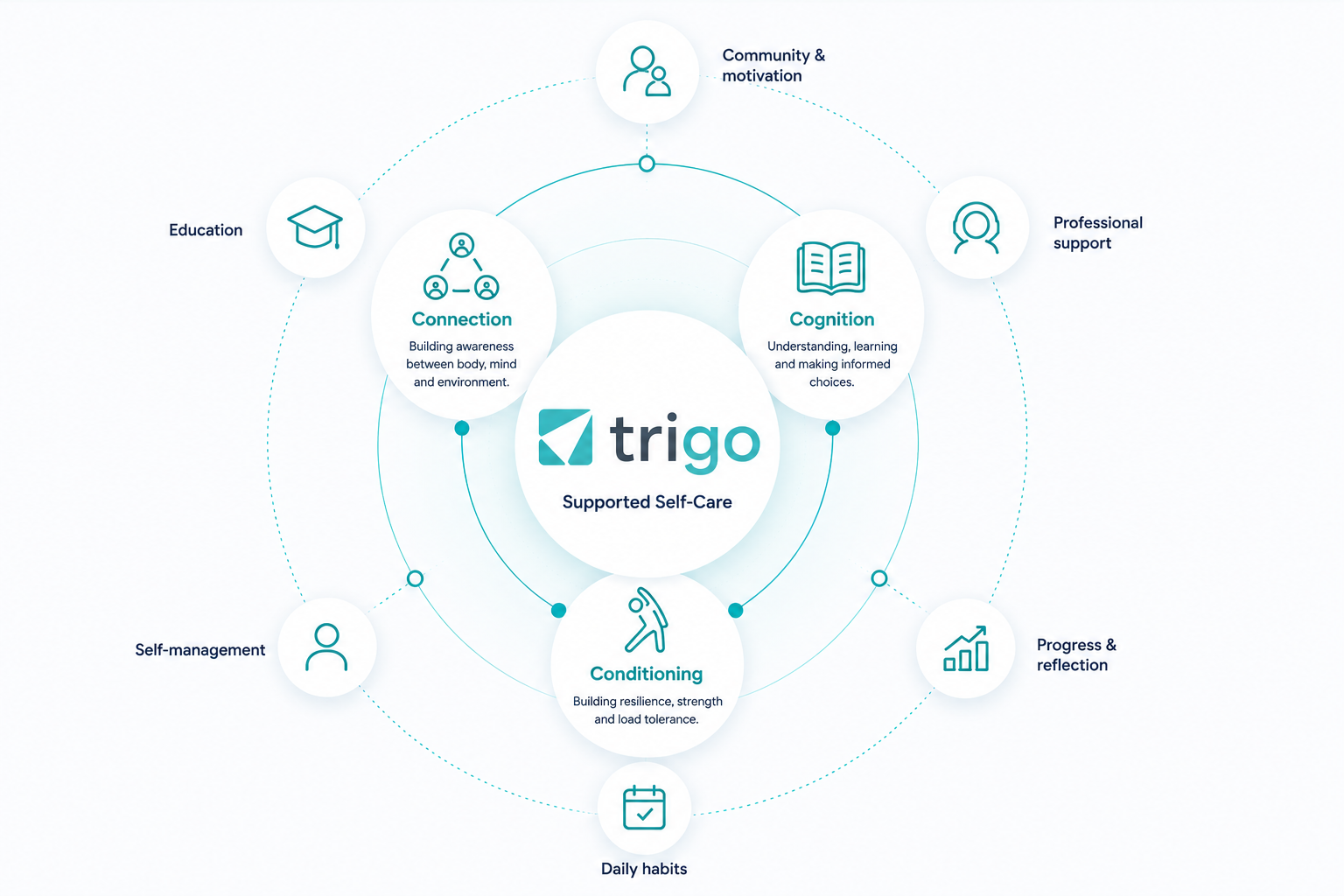
How Supported Self-Care Influenced Trigo
Supported self-care is not simply a feature within Trigo.
It is one of the platform’s foundational principles.
Our starting point was not:
“How do we deliver more appointments?”
Instead, we asked:
“How do we help people participate more actively in their own health?”
The evidence reviewed by Baumbach et al. (2024), together with wider behaviour change and engagement research, frames this via several recurring principles.
People benefit from:
- Clear goals.
- Accessible guidance.
- Progress visibility.
- Ongoing encouragement.
- Access to professional expertise.
These principles reflect how Trigo was designed.
The platform seeks to create an environment where individuals can engage with their own health while retaining access to support when required.
Supported self-care therefore becomes more than a clinical concept.
It becomes a practical operating model.
Building Sustainable Change
One of the most important lessons emerging from healthcare research is that sustainable outcomes rarely depend upon isolated interventions.
Meaningful change often results from small actions repeated consistently over time.
This is particularly relevant for:
- Physical activity.
- Musculoskeletal health.
- Sleep.
- Lifestyle behaviours.
- Preventive health.
Supported self-care creates conditions that encourage these small actions.
- It helps people remain connected to their goals.
- It provides structure during periods when motivation fluctuates.
- It reinforces the idea that health is not something delivered by professionals alone.
- It is something created through participation.
Looking Forward
Healthcare systems face growing pressure to improve outcomes while using resources responsibly.
The evidence increasingly suggests that active participation has an important role to play.
Research reviewed by Baumbach et al. (2024) supports self-management and active rehabilitation approaches.
Behaviour change research highlights the importance of engagement.
Workplace health research reinforces the value of participation.
Taken together, these findings point towards a common conclusion.
People achieve the greatest benefit when they are supported to become active participants in their own health.
- Not isolated.
- Not unsupported.
- But supported.
This distinction matters.
At Trigo, it has become one of the principles guiding how we think about prevention, wellbeing and healthcare delivery.
Because the future of healthcare is unlikely to depend solely on what happens during appointments.
It will also depend on what happens between them.
References
- Baumbach, P., Roheger, M., Katalinic, O. M., et al. (2024). Cost-Effectiveness of Treatments for Musculoskeletal Conditions Offered by Physiotherapists: A Systematic Review. Sports Medicine – Open.
- Milne-Ives, M., et al. (2023). Potential Associations Between Behaviour Change Techniques and Engagement With Mobile Health Apps.
- Edwards, E. A., Lumsden, J., Rivas, C., et al. (2016). Gamification for Health Promotion: Systematic Review of Behaviour Change Techniques in Smartphone Apps. BMJ Open.
- Alzghoul, A., Alkhazaleh, Z., Alkhawaldeh, M., et al. (2024). The Effectiveness of Gamification in Health and Wellbeing: A Systematic Review and Meta-Analysis. The Open Public Health Journal.
- Odeen, M., Magnussen, L. H., Maeland, S., Larun, L., Eriksen, H. R., & Tveito, T. H. (2013). Systematic Review of Active Workplace Interventions to Reduce Sickness Absence. Occupational Medicine.
- Tarro, L., Llauradó, E., Ulldemolins, G., Hermoso, P., Solà, R., & Moriña, D. (2020). Effectiveness of Workplace Interventions for Improving Absenteeism, Productivity and Work Ability of Employees: A Systematic Review and Meta-Analysis of Randomized Controlled Trials. International Journal of Environmental Research and Public Health, 17(6), 1901.
- Cancelliere, C., Cassidy, J. D., Ammendolia, C., & Côté, P. (2011). Are Workplace Health Promotion Programs Effective at Improving Presenteeism in Workers? A Systematic Review and Best Evidence Synthesis of the Literature. BMC Public Health.