
For many insurers, musculoskeletal claims follow a familiar pattern. A claimant reports a condition. Treatment is authorised. The claimant selects a provider. The treatment pathway proceeds largely outside the insurer’s visibility and control. The insurer knows how many appointments are funded, but often has less visibility into whether those appointments were the minimum necessary to achieve the desired outcome. The challenge is not authorisation. The challenge is optimisation.
A different approach
Trigo was designed around a simple principle. Before treatment begins, every claimant should have rapid access to a physiotherapist who can help determine the most appropriate pathway. Rather than immediately entering a treatment programme, claimants receive an early professional assessment through a rapid-access digital consultation. Some claimants may be suitable for a digitally supported pathway. Others may require hands-on treatment. Some may benefit from a hybrid approach. The important point is that the decision is made using professional assessment rather than assumptions.
Faster access, stronger engagement
One of the most significant findings from a recent insurer pilot was the level of claimant engagement achieved through rapid access. Almost four out of five referred claimants successfully registered and engaged with the service. More than eight out of ten registered users progressed to a professional assessment. Attendance at initial assessments exceeded expectations, with no recorded failures to attend. These findings suggest that rapid access to a physiotherapist creates a strong sense of responsiveness and support, encouraging engagement at the earliest stage of the claim journey.
Better routing into the right pathway
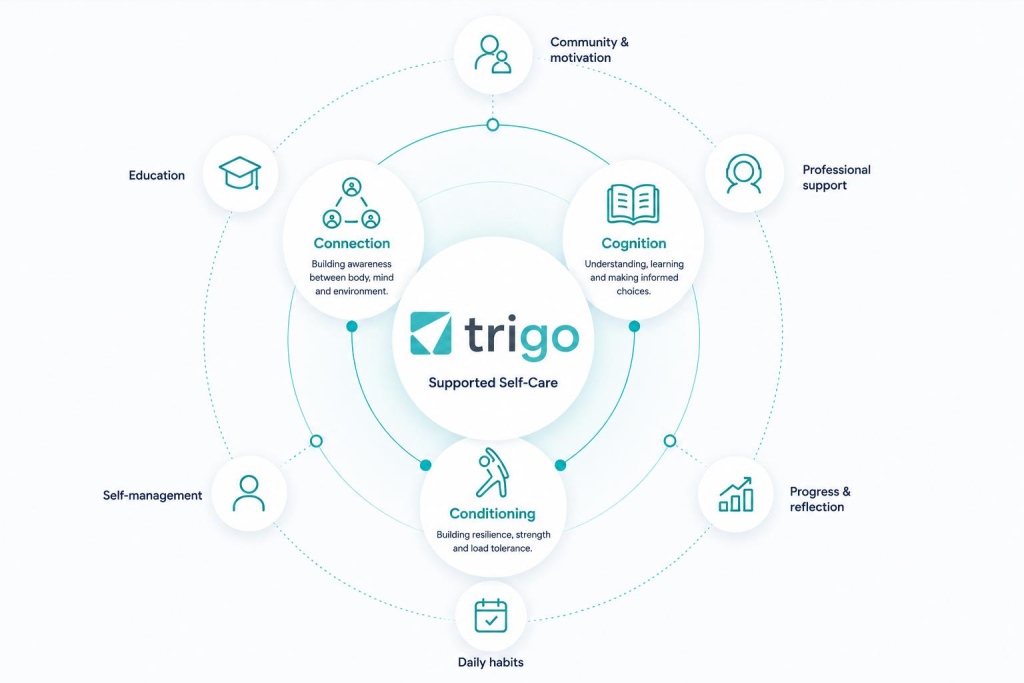
Not every claimant requires the same type of intervention. Following assessment, users were directed into the most appropriate pathway based on professional judgement and patient preference. Where digital treatment was suitable and accepted, users entered a Trigo-managed supported self-care programme. Where digital treatment was not suitable, or where users preferred hands-on care, recommendations were provided regarding likely treatment requirements before referral into the wider physiotherapy network. This created an additional layer of utilisation management that does not typically exist within traditional open-authorisation models.
Creating the potential for lower utilisation
Within digitally managed cases, average treatment intensity was 2.46 clinical contacts per case. This demonstrates the potential for a supported self-care model to deliver care efficiently while maintaining professional oversight. The pilot demonstrated that a professionally managed digital pathway can operate with substantially fewer clinician contacts than many traditional treatment models, creating opportunities for improved efficiency and cost control.
The future of insurer-led musculoskeletal care
The opportunity for insurers is not simply digitising treatment. It is creating greater visibility, earlier intervention and more intelligent utilisation management. A rapid-access front-door model gives insurers the ability to improve claimant experience through faster access, increase engagement and attendance, route claimants into more appropriate pathways, improve visibility of treatment utilisation, support more efficient allocation of clinical resources and create the foundations for better cost control. For insurers seeking new approaches to musculoskeletal care, the future may not lie in authorising more treatment. It may lie in optimising treatment before it begins.
Pilot data available on request. Results derived from a musculoskeletal pilot conducted with a leading Norwegian insurer.