
Healthcare Was Never Designed for the Challenges We Face Today
Across Europe and much of the developed world, healthcare systems are under increasing pressure.
People are living longer. Chronic conditions are becoming more common. Mental health concerns are growing. Musculoskeletal complaints remain one of the leading causes of disability and sickness absence. At the same time, healthcare providers face workforce shortages, increasing demand and finite resources.
In response, healthcare systems have traditionally done what they were designed to do: treat illness.
When someone develops a health problem, they enter a pathway of assessment, diagnosis and intervention. For many conditions, this approach works well. Modern healthcare has transformed outcomes across countless areas of medicine.
However, there is a growing recognition that many of today’s health challenges cannot be solved through treatment alone.
The question increasingly being asked by researchers, policymakers and employers is not simply:
“How do we treat people when they become unwell?”
It is:
“How do we help people stay well in the first place?”
This question sits at the heart of a growing body of research exploring digital wellbeing.
It is also one of the questions that ultimately influenced the development of the Trigo platform.
The Evolution from Digital Health to Digital Wellbeing
For many years, the term digital health was primarily associated with healthcare delivery.
Digital systems helped clinicians:
- Record patient information.
- Deliver consultations.
- Monitor health conditions.
- Support diagnosis and treatment.
These remain important functions.
However, researchers have increasingly recognised that health is influenced by far more than clinical interventions alone.
In their systematic scoping review, Smits et al. (2022) describe an emerging shift from digital health towards digital wellbeing.
This distinction is important.
Digital health is largely concerned with healthcare services.
Digital wellbeing takes a broader view.
It includes:
- Prevention.
- Behaviour change.
- Lifestyle support.
- Self-management.
- Quality of life.
- Social wellbeing.
- Ongoing participation in health.
The focus moves beyond managing illness and towards supporting wellbeing.
This represents a significant change in perspective.
Rather than asking:
“How do we deliver treatment digitally?”
the question becomes:
“How can digital tools help people make healthier decisions, build healthier habits and maintain wellbeing over time?”
The implications of this shift are profound.
Why Prevention Is Becoming More Important
Most healthcare systems were built around episodes of care.
- A problem occurs.
- A patient enters the system.
- Treatment is provided.
- The episode concludes.
Many modern health challenges do not fit neatly into this model.
Musculoskeletal complaints, inactivity, stress, poor sleep and lifestyle-related health risks often develop gradually over time.
The same is true of many factors associated with workplace absence and reduced productivity.
In these situations, prevention becomes critically important.
The challenge is that prevention has historically been difficult to deliver consistently and at scale.
Traditional healthcare systems are excellent at treating illness.
They are less well suited to supporting thousands of small daily decisions that influence long-term health outcomes.
Digital technologies may help address this gap.
Smits et al. (2022) argue that digital wellbeing systems create opportunities to support individuals before they require formal healthcare intervention.
Rather than waiting for problems to emerge, support can be embedded into everyday life.
This concept resonated strongly with our thinking at Trigo.
The Missing Ingredient: Participation
Of course, providing digital tools does not automatically create better outcomes.
One of the most consistent themes emerging from the wider evidence base is that participation matters.
Research by Howarth et al. (2018) and Sevic et al. (2023) demonstrates that digital workplace health interventions can positively influence employee health behaviours.
However, both reviews identify a recurring challenge.
People must remain engaged.
Simply making services available is rarely sufficient.
Participation becomes the bridge between support and outcomes.
This observation is important because it challenges a common misconception.
Many organisations evaluate wellbeing initiatives according to what is offered.
The evidence increasingly suggests that what matters most is whether people actually participate.
This distinction has significant implications for the future of digital wellbeing.
Why Engagement Is a Health Outcome
Traditionally, engagement has often been treated as a technology metric.
Logins.
Page views.
Session duration.
Yet the evidence suggests engagement may be something much more important.
Milne-Ives et al. (2023) reviewed behaviour change techniques associated with engagement in digital health interventions and identified several recurring themes.
Users were more likely to remain engaged when interventions included:
- Goal setting.
- Progress tracking.
- Self-monitoring.
- Feedback.
- Social support.
These mechanisms help people remain connected to their health goals over time.
Engagement therefore becomes more than a measure of platform usage.
It becomes a mechanism through which behaviour change may occur.
This insight has shaped the development of many modern wellbeing platforms, including Trigo.
Our view is that people are more likely to improve outcomes when support becomes part of their daily lives rather than an occasional healthcare event.
The Rise of Supported Self-Management
Another important theme emerging from the literature is self-management.
Healthcare systems increasingly recognise that individuals play an active role in determining their own health outcomes.
This is not a new concept.
What is changing is our ability to support self-management effectively.
Digital technologies can provide:
- Education.
- Guidance.
- Tracking.
- Feedback.
- Communication.
- Access to professional support.
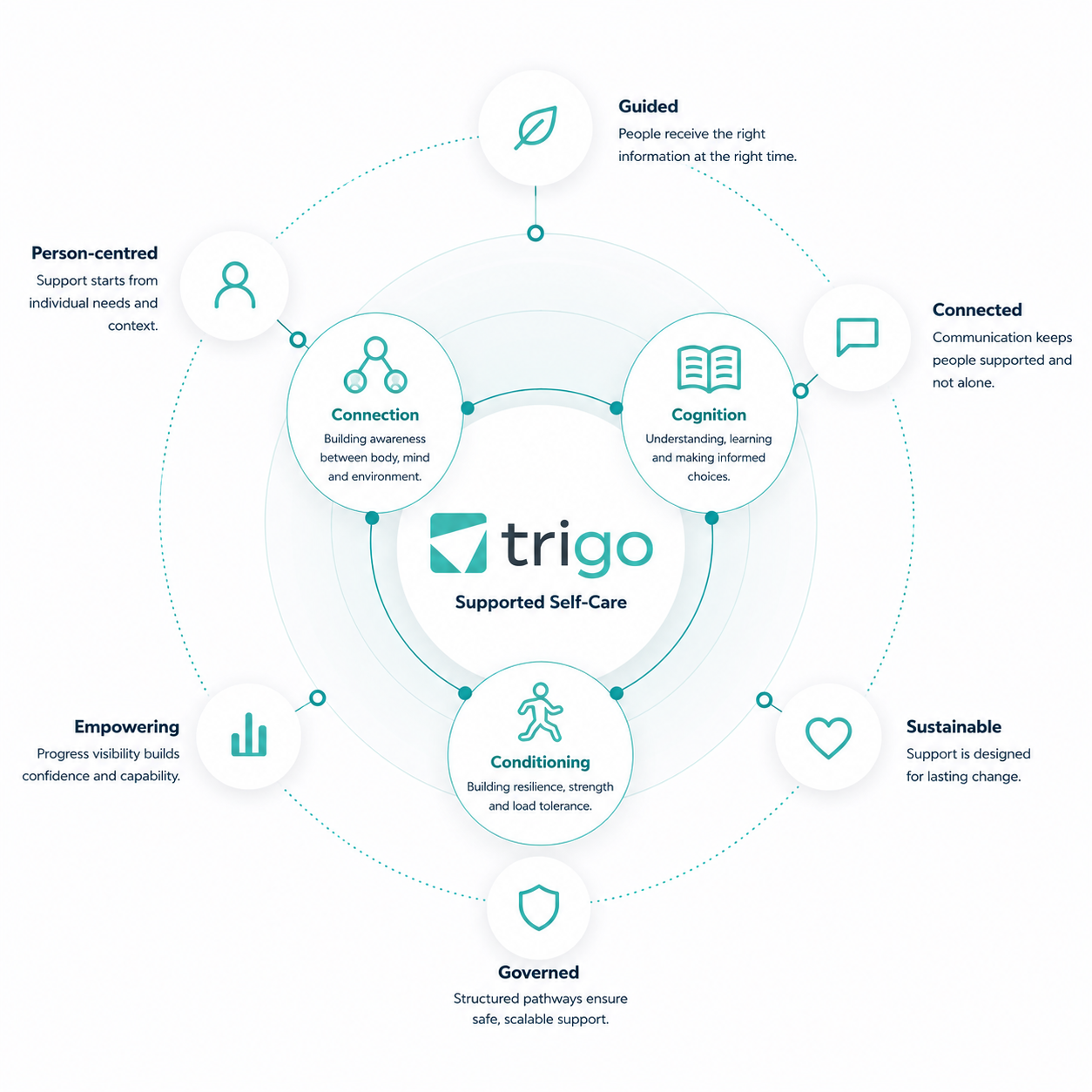
Together, these capabilities create opportunities for what we often describe as supported self-care.
The distinction is important.
Unsupported self-care assumes people can navigate health challenges alone.
Supported self-care recognises that people often benefit from guidance, structure and professional input.
Research reviewed by Baumbach et al. (2024) highlights the value of active participation and self-management approaches within musculoskeletal care.
These findings align with a broader trend across healthcare.
People often achieve better outcomes when they become active participants rather than passive recipients of care.
Digital wellbeing creates new opportunities to support this process.
Beyond Healthcare Delivery
One of the most interesting implications of digital wellbeing is that it extends beyond healthcare itself.
Health influences:
- Workforce participation.
- Productivity.
- Work ability.
- Quality of life.
- Social participation.
This is why employers, insurers and municipalities are increasingly interested in wellbeing.
Research by Odeen et al. (2013), Tarro et al. (2020) and Cancelliere et al. (2011) suggests that workplace interventions can positively influence outcomes including work ability, productivity, presenteeism and sickness absence.
Importantly, these studies do not suggest that digital tools alone create these outcomes.
Instead, they reinforce the importance of participation, activity, support and behaviour change.
Digital wellbeing platforms create opportunities to deliver these elements more consistently and at greater scale.
This broader perspective is one reason why digital wellbeing is becoming increasingly relevant beyond traditional healthcare settings.
How This Influenced Trigo
When we began developing Trigo, we did not start with technology.
We started with a question.
How can we help more people participate actively in their own health?
The research described above did not provide a blueprint, in fact much of it had not been written at that point.
It has, however, provided a set of principles as we evolved Trigo.
Digital wellbeing literature suggested that prevention and participation deserve greater attention.
Behaviour change research highlighted the importance of engagement.
Self-management research reinforced the value of active participation.
Workplace health research demonstrated that wellbeing has implications far beyond healthcare utilisation.
Together, these findings influenced our thinking.
Rather than building a platform focused solely on appointments or treatment episodes, we sought to create an environment that supports:
- Engagement.
- Participation.
- Self-management.
- Access to professional support.
- Ongoing wellbeing.
In many ways, Trigo represents an attempt to bring these evidence-informed principles together within a single experience.
What This Means for Organisations
For employers, insurers and municipalities, the shift towards digital wellbeing presents both an opportunity and a challenge.
The opportunity is clear.
Digital technologies create new possibilities for supporting health at scale.
The challenge is ensuring that these systems genuinely help people participate rather than simply providing another digital service.
The evidence increasingly suggests that successful wellbeing strategies require more than information.
- They require engagement.
- They require participation.
- They require support.
Digital wellbeing is therefore not simply about technology.
It is about creating conditions that help people make healthier decisions and sustain healthier behaviours over time.
Looking Forward
Healthcare will always require clinicians, treatment pathways and specialist expertise.
Digital wellbeing is not intended to replace these things.
Nor does the evidence suggest it should.
Instead, digital wellbeing represents an expansion of how we think about health.
It shifts some attention towards prevention.
Towards participation.
Towards supporting wellbeing before health problems become significant enough to require intensive intervention.
This perspective is increasingly reflected across the research literature.
It is also reflected in the way we think about health at Trigo.
The future of healthcare will not be built on technology alone.
It will be built on the thoughtful combination of evidence, human support and practical tools that help people engage with their own wellbeing.
That journey starts long before someone becomes a patient.
References
- Smits, M., van Velthoven, M. H., Kotz, D., et al. (2022). From Digital Health to Digital Well-being: Systematic Scoping Review. Journal of Medical Internet Research.
- Howarth, A., Quesada, J., Silva, J., Judycki, S., Mills, P. R., & Schiavo, J. H. (2018). The Impact of Digital Health Interventions on Health-Related Outcomes in the Workplace: A Systematic Review. Digital Health, 4.
- Sevic, S., Müssig, M., Bredemeier, J., et al. (2023). Effectiveness of eHealth Interventions Targeting Employee Health Behaviors: Systematic Review. Journal of Medical Internet Research, 25:e38307.
- Milne-Ives, M., et al. (2023). Potential Associations Between Behaviour Change Techniques and Engagement With Mobile Health Apps.
- Baumbach, P., Roheger, M., Katalinic, O. M., et al. (2024). Cost-Effectiveness of Treatments for Musculoskeletal Conditions Offered by Physiotherapists: A Systematic Review. Sports Medicine – Open.
- Odeen, M., Magnussen, L. H., Maeland, S., Larun, L., Eriksen, H. R., & Tveito, T. H. (2013). Systematic Review of Active Workplace Interventions to Reduce Sickness Absence. Occupational Medicine.
- Tarro, L., Llauradó, E., Ulldemolins, G., Hermoso, P., Solà, R., & Moriña, D. (2020). Effectiveness of Workplace Interventions for Improving Absenteeism, Productivity and Work Ability of Employees: A Systematic Review and Meta-Analysis of Randomized Controlled Trials. International Journal of Environmental Research and Public Health, 17(6), 1901.
- Cancelliere, C., Cassidy, J. D., Ammendolia, C., & Côté, P. (2011). Are Workplace Health Promotion Programs Effective at Improving Presenteeism in Workers? A Systematic Review and Best Evidence Synthesis of the Literature. BMC Public Health.